
Three Levels of Mind

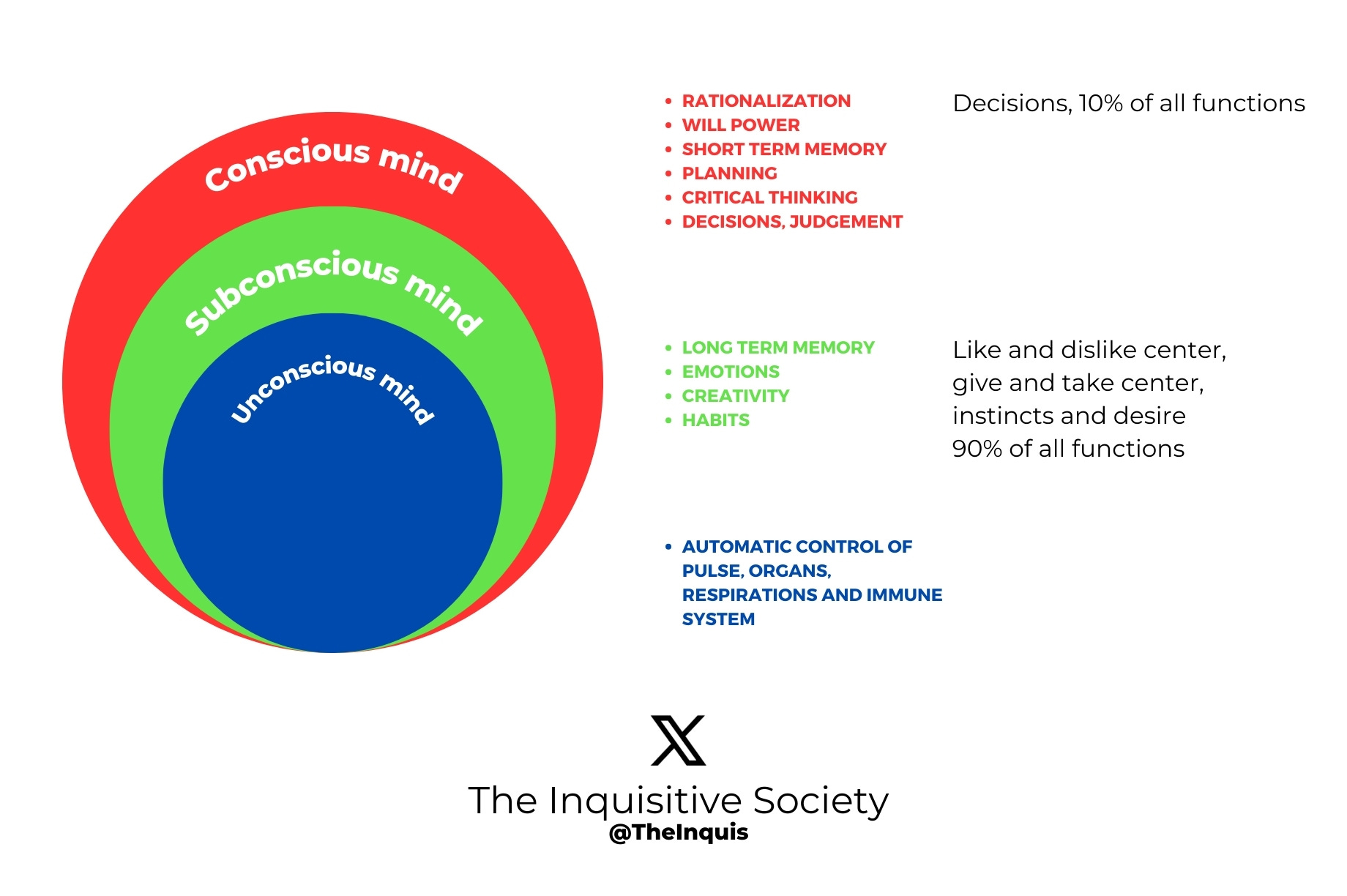
These three levels of the mind were first theorized by Sigmund Freud, who proposed a vertical and hierarchical structure of human consciousness. According to his theory, the conscious mind (or ego) is the tip of the iceberg, representing only a small portion of our mental processes.
Below the conscious mind lies the unconscious mind, which influences our thoughts and behavior without our awareness. The subconscious mind acts as an intermediary between the unconscious and the conscious mind.
The mind is an intricate and dynamic system that is constantly processing information based on comparisons and creates assumptions to predict an outcome which then triggers certain parts of the brain to release chemicals that prepare the body for the predicted outcome.
Much as we like to think of ourselves as rational beings, more often than not we are driven by the many emotional responses that arise in the limbic system, responses of which we only become aware after the event — as they are generated unconsciously.
- Changing with NLP; Dr. Lewis Walker
The conscious mind
This is the logical thinking and decision-making part of our mind, where we are actively aware of our thoughts, perceptions, and feelings. It encompasses our rational thinking, deliberate actions, and intentional behaviors.
The subconscious mind
Also known as the preconscious mind, this part of our mind processes information automatically, often without our realizing it. It holds mental processes and memories that are not currently in our conscious awareness, but can be accessed when needed. This includes information that is just below the surface of consciousness and can be brought into conscious awareness with some focus and effort.
The unconscious mind
This is the storehouse of our memories, emotions, and experiences, which shapes our perception of the world. The unconscious mind consists of automatic processes that occur below the level of conscious awareness, making them very hard to access for introspection. This includes repressed feelings and desires, as well as memories, automatic skills, subliminal perceptions, and automatic reactions.
Unlike the subconscious mind, the unconscious mind is not easily accessible to conscious awareness, most of people will never (directly) interact with it, it is only through deep states of meditation and hypnosis that the gate to this part of the mind is unlocked.